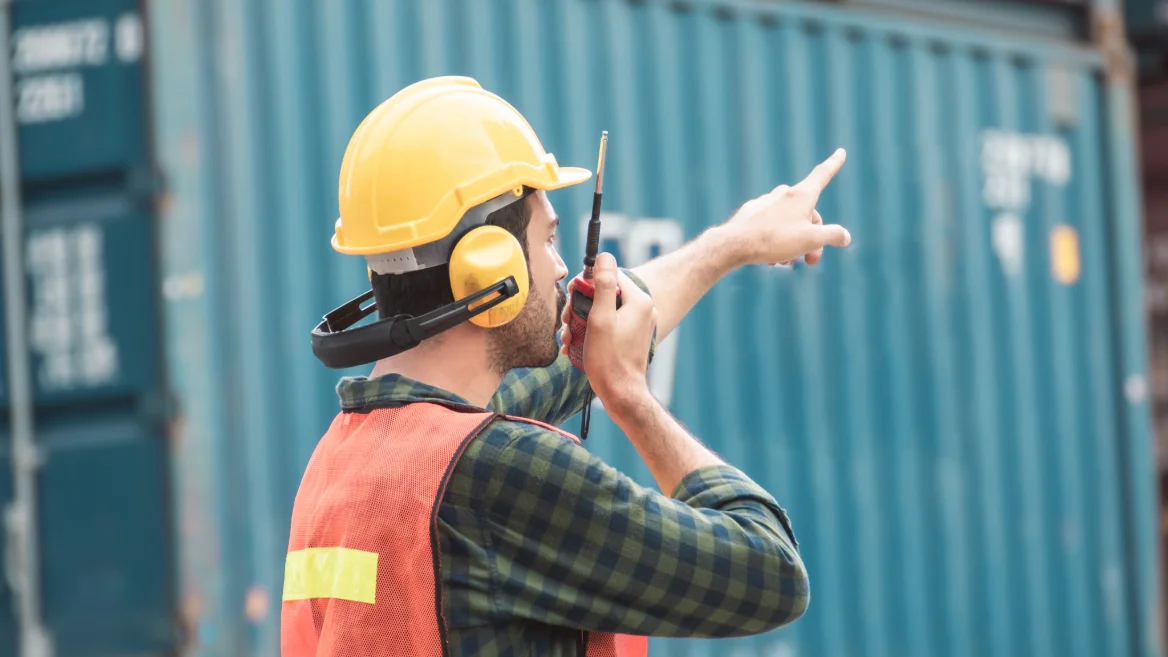
Large vehicles moving through busy yards, warehouses and logistics hubs often operate in tight spaces with limited visibility. Reversing an articulated lorry into a loading bay, for example, can be difficult even with mirrors and cameras.
That’s where banksmen come in.
A banksman helps guide vehicles safely during manoeuvres where the driver cannot clearly see what’s around them. From busy distribution centres to construction sites, banksmen play a vital role in maintaining HGV safety and preventing accidents across the transport industry.
You may also hear the role referred to as a vehicle marshal, but the core responsibility remains the same: guiding vehicle movements safely on the ground.
What we’ll cover
Fleets, bookings, subcontractors, compliance & payments.
With HX, you can manage them all in one place.
What is a banksman?
A banksman is a trained person responsible for directing vehicle movements in situations where a driver’s visibility is limited. Their main task is to guide vehicles — particularly HGVs — when reversing or manoeuvring in confined areas.
In haulage environments, banksmen often assist with:
- Reversing HGVs into loading bays
- Guiding vehicles through tight depot yards
- Managing traffic in busy distribution areas
- Ensuring safe vehicle movements around pedestrians and equipment
Because large commercial vehicles have significant blind spots, drivers often rely on a banksman to act as their eyes on the ground.
Banksmen are commonly used by:
- Haulage companies
- Distribution centres
- 3PL logistics providers
- Construction sites receiving freight deliveries
- Ports and freight terminals
In many workplaces, a banksman must be present before certain manoeuvres — particularly reversing — are allowed to take place.
Why banksmen are important for HGV safety
Large vehicles such as articulated trucks and rigid HGVs have substantial blind spots around the cab and trailer. Even with modern cameras and mirrors, drivers cannot always see obstacles or people close to the vehicle.
This is why banksmen are essential for maintaining HGV safety in busy environments.
A banksman helps reduce the risk of:
- collisions with pedestrians
- damage to buildings, loading bays or other vehicles
- contact with forklifts or warehouse equipment
- accidents during reversing manoeuvres
Their presence is especially important in environments with heavy vehicle movement, such as large logistics hubs or busy depot yards.
Banksmen are also useful when handling more complex vehicle movements, including manoeuvring wide or abnormal loads or positioning longer heavier vehicles (LHVs) where space is limited. In these situations, having someone guide the driver from outside the vehicle greatly improves safety and accuracy.
Where banksmen are used in haulage
Banksmen are most commonly found wherever large vehicles need to manoeuvre in confined or busy areas.
Typical environments include:
- Distribution centre yards
- Warehouse loading bays
- Freight terminals and ports
- Construction sites receiving deliveries
- Industrial estates and restricted delivery areas
For example, an HGV arriving from a long haulage trunking journey may need to reverse into a narrow loading dock at a warehouse. In this situation, a banksman can guide the driver safely into position while keeping the surrounding area clear.
Banksmen are also an important part of yard management at busy transport depots, helping to coordinate vehicle movements and maintain safe working conditions for staff.
How banksmen guide HGVs safely
The role of a banksman involves more than simply waving a vehicle into place. Clear communication and correct positioning are essential.
A banksman typically:
- stands where the driver can clearly see them in their mirrors
- maintains eye contact with the driver where possible
- uses clear hand signals to guide the vehicle
- checks that the vehicle’s path is clear of hazards
- stops the vehicle immediately if something becomes unsafe
Communication between the driver and banksman must always be clear and consistent. If the driver loses sight of the banksman, they should stop the vehicle immediately until communication is re-established.
In some environments, banksmen may also use radios or other communication tools to assist with vehicle guidance.
Common banksman hand signals
Banksmen use standard hand signals to communicate with drivers during manoeuvres. These signals help guide the vehicle safely and clearly.
Common signals include:
- Reverse slowly – guiding the driver to continue reversing carefully
- Stop – instructing the driver to stop immediately
- Move left or right – adjusting the vehicle’s direction
- Continue straight – indicating that the path is clear
Signals must always be visible and easy for the driver to understand. If signals become unclear or the banksman is no longer visible, the driver should stop the vehicle straight away.
Banksman vs vehicle marshal: what’s the difference?
The terms banksman and vehicle marshal are often used interchangeably, and in most cases they refer to the same role.
Traditionally, banksman has been the common term used in construction and logistics environments. Meanwhile, vehicle marshal is often used in safety training courses and formal site policies.
| Term | Typical use |
|---|---|
| Banksman | Common in haulage yards, construction sites and depots |
| Vehicle marshal | Often used in safety training or formal workplace policies |
Regardless of the name used, the responsibility remains the same: guiding vehicles safely and preventing accidents during manoeuvres.
Banksman training and responsibilities
Because the role involves directing large vehicles, banksmen must receive proper training before performing the job.
Typical training covers:
- Safe vehicle marshalling techniques
- Recognised hand signals
- Hazard awareness around HGVs
- Communication procedures with drivers
Banksmen must also wear appropriate personal protective equipment (PPE), such as high-visibility clothing, to ensure they are clearly visible at all times.
Proper training ensures that banksmen can safely support vehicle movements in busy environments such as depots, warehouses and other logistics facilities.
Banksmen FAQs
What does a banksman do in logistics?
A banksman guides vehicle movements where a driver’s visibility is limited. They typically assist HGV drivers when reversing or manoeuvring in confined areas, using hand signals or other communication methods to ensure the vehicle moves safely.
Why are banksmen important for HGV safety?
Banksmen help prevent accidents by guiding drivers through blind spots and restricted spaces. They reduce the risk of collisions with pedestrians, equipment or infrastructure, particularly in busy depot yards and logistics hubs.
Is a banksman the same as a vehicle marshal?
In most cases, yes. Banksman and vehicle marshal refer to the same role. Both involve directing vehicle movements safely, although the term vehicle marshal is sometimes used in formal safety training.
Do banksmen need training?
Yes. Banksmen should receive training in vehicle marshalling techniques, recognised hand signals, communication procedures and hazard awareness around large vehicles such as HGVs.